A custom dog tag has one job: get your dog home fast when someone finds him. That makes the engraving decision more consequential than it looks, because a tag is only as good as the information on it and how easily a stranger can read it in a parking lot. This is a practical walkthrough of what to put on a pet ID tag, what to leave off, and how to fit it all without shrinking the type into a blur.
The one line that matters most
A current phone number is the single most important thing on the tag, and if there is room, a second number for a partner, family member, or friend adds a crucial backup. Everything else is secondary to a stranger being able to reach you within a minute of finding your dog. Use a mobile number you actually carry, not a landline you rarely answer, because reunions happen fastest when the finder gets a live person rather than a voicemail. If you only have space for one thing, it is this.
It helps to understand why the tag outranks the microchip for speed even though both matter. A chip is a backup that requires the dog to reach a shelter or vet with a working scanner and a correctly registered account. A tag works the instant a neighbor reads it. The two are complements, not substitutes, which the return-to-owner data makes plain.
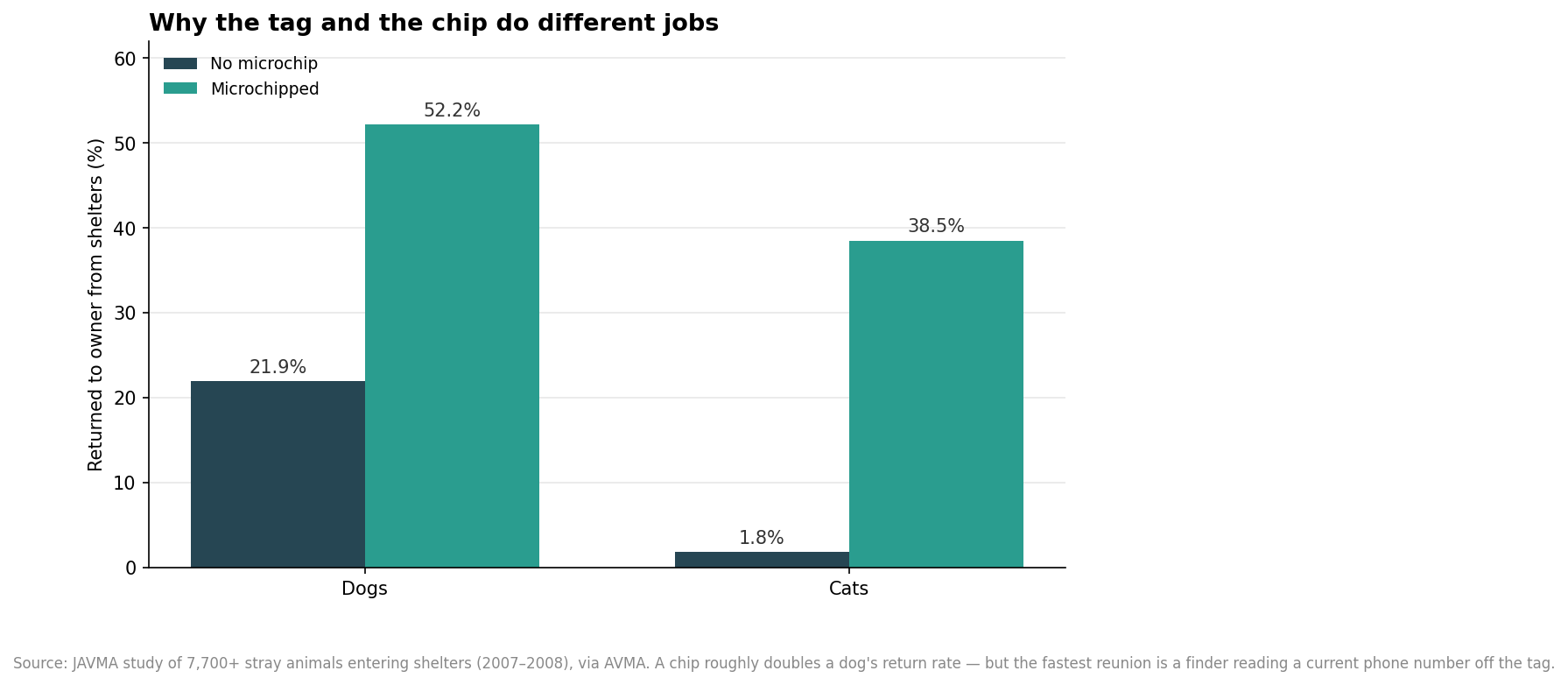
The takeaway from that data: a microchip roughly doubles a dog’s odds of getting home from a shelter, but the study’s authors found the usual reason chipped animals still weren’t reunited was incorrect or missing registration information. A tag with a phone number you can answer today short-circuits that whole failure mode. Wear the tag and keep the chip registration current; neither replaces the other.
What else earns a spot
After the phone number, a few additions pull their weight. Your city or general area helps a finder who has traveled, and it signals where to focus if the dog has roamed. A short “Microchipped” or “Scan me” note prompts a shelter or vet to check for a chip, closing the loop between your two layers of ID. If your dog has a medical condition, a clear “Needs meds,” “Diabetic,” or “Epileptic” line can be genuinely life-saving and tells a finder this is a dog to help quickly rather than hold onto. Finally, a brief reassurance like “I’m friendly” or a nudge like “Call my owner” costs little and can make a nervous finder more willing to approach and help.
What to think twice about
Two common inclusions deserve a deliberate decision rather than a default. The first is your full home address. Most guidance advises against engraving a complete street address, since the tag can end up in a stranger’s hands and a city or area gives a finder enough to work with. The second is your dog’s name, and here reasonable people disagree. Including it lets a finder speak to and calm an anxious dog, which can make the difference between catching him and watching him bolt. Omitting it is a security preference for owners worried that a stranger who can call the dog by name could more easily coax or claim him. There is no universally correct answer; decide based on your own risk tolerance, and know that the phone number, not the name, is what actually gets the dog home.
Fitting it all without losing legibility
Every extra line competes for space, and a tag crammed with tiny text fails at the exact moment it is needed. Prioritize ruthlessly: the phone number is non-negotiable, and each additional item has to earn its place against the cost of shrinking every character. Before you reduce the font, use the back of the tag, since a two-sided engraving roughly doubles your capacity while keeping the type large. Larger tags obviously hold more, but they are not always practical on a small dog, so the realistic move is to match the information to the tag size rather than force six lines onto a face built for three.
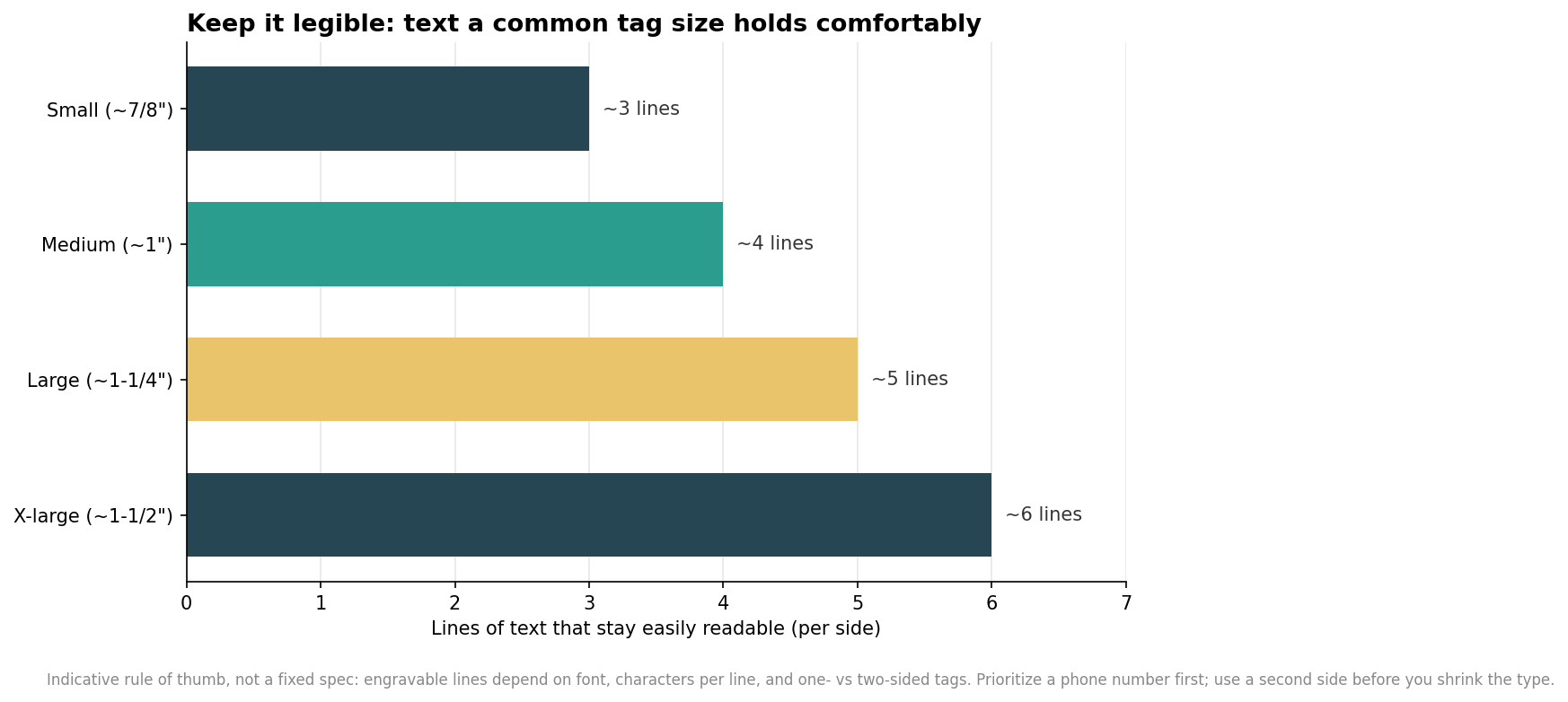
Treat the figures above as a rule of thumb rather than a hard limit, because the true capacity depends on your font, how many characters sit on each line, and whether you engrave one side or two. A phone number with an area code is already a full line on a small tag, which is exactly why prioritizing matters.
Ordering tags in volume
The same rules scale up when the tags are for a rescue, shelter, breeder, veterinary clinic, or an adoption event rather than a single pet. In bulk, the smart move is to fix the layout and engraving depth once, decide as a policy what goes on every tag, and leave a variable field for the phone number and any per-animal detail. A rescue might standardize on its own contact number and a “Microchipped” line so every adopted dog leaves with working ID on day one, then hand the new owner instructions to add their own number. Locking the template keeps a large run consistent and readable instead of leaving legibility to chance tag by tag.
A simple specification that works
For most dogs, a durable tag engraved with two phone numbers, your city, and a short “Microchipped” note covers the essentials while staying easy to read, with medical information added when it applies and the dog’s name left to your judgment. Choose a tag size that holds that content at a comfortable type size instead of the smallest tag you can find, use both sides before you shrink the font, and pair the tag with a microchip whose registration you keep current. Do that, and the tag will do the one thing you bought it for: turn a lost dog back into a found one, quickly.