The classic dog tag is one of the most copied objects in the personalization business. The oval stainless plate on a beaded chain that reads as unmistakably military shows up on custom orders for reunions, teams, memorials, promotional runs, and fashion, and almost all of them trace back to a single format the armed forces settled on decades ago. Understanding that original specification is useful whether you want a faithful reproduction or a custom tag that borrows the look while changing the details. This is a plain explainer of the standard and what versions built on it keep and drop.
The tag itself: size, metal, and shape
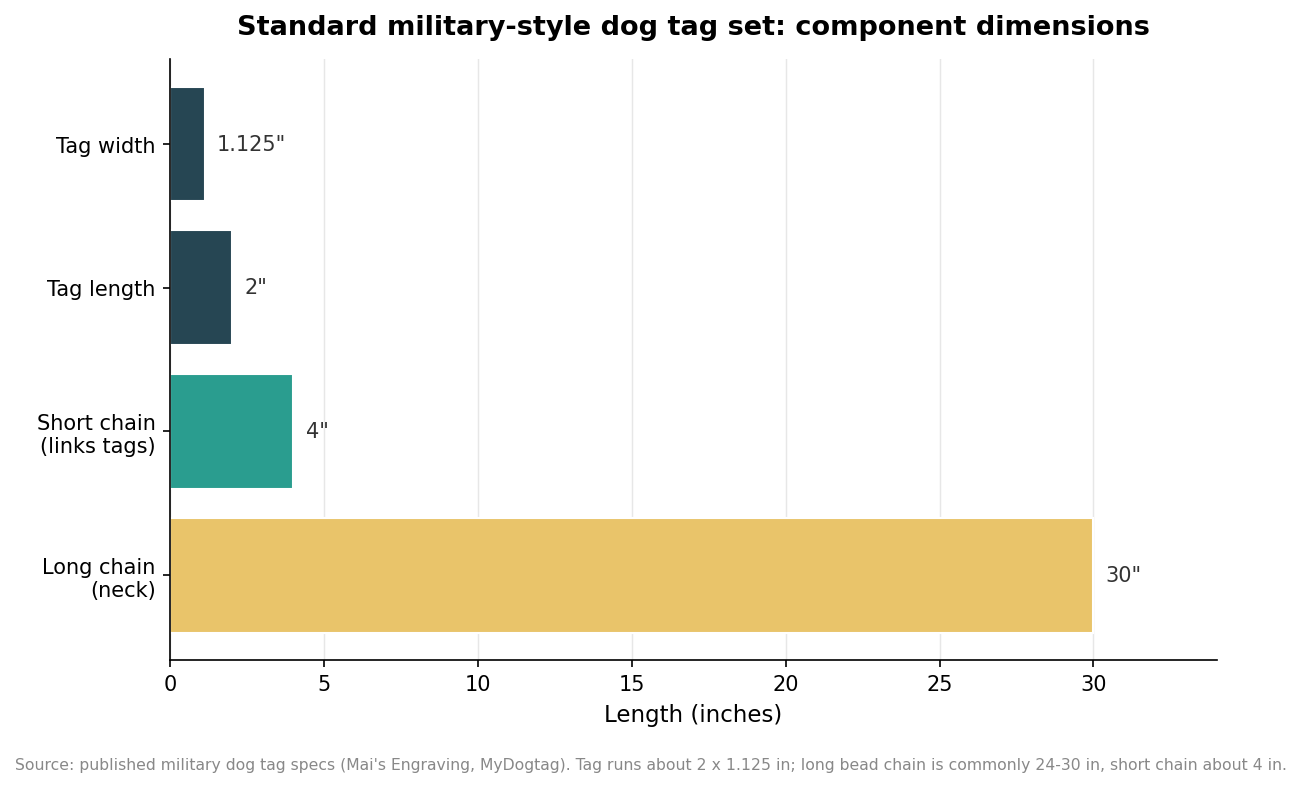
The standard tag is small, and its size is deliberate. A regulation-style dog tag measures roughly 2 inches long by 1.125 inches wide, cut from stainless steel with rounded corners and a thin profile on the order of a few hundredths of an inch. Stainless is the material of record because it resists corrosion and holds up for a lifetime of wear against skin and clothing, which is exactly why custom makers default to it as well. A single hole at one end takes the chain. That compact footprint is the constraint everything else works within: there is only so much room on a 2-inch plate, which is why the text rules that follow matter so much.
Embossed now, debossed then
The difference between raised and sunken lettering is the clearest marker of era on a dog tag. Modern military tags are embossed, meaning the letters stand raised above the surface, pressed up by a machine that pushes the metal outward. Raised characters are easier to read and to feel, and they hold contrast even as the surface wears. Tags from the World War II through Vietnam periods were typically debossed, with letters stamped down below the surface, which reads less cleanly and can fill with grime over time. When a custom order specifies an authentic period look, this is the detail that sells it; when it specifies readability, embossing is the better choice. The distinction also affects tooling, because raised and sunken lettering are produced on different machines.
How much text actually fits
The regulation layout is five lines, and the historical convention filled them with a service member’s name, identification number, blood type, and religious preference. What custom buyers most often underestimate is how tight those lines are. On a 2-inch tag, an embossing machine fits somewhere in the range of 15 to 18 characters per line depending on the pitch, which is characters per inch, and whether the text sits in the standard or a shifted position. The chart below shows those approximate upper bounds. Only capital letters, digits, and a few punctuation marks such as the dash, period, and comma are available, so lowercase and symbols are out.
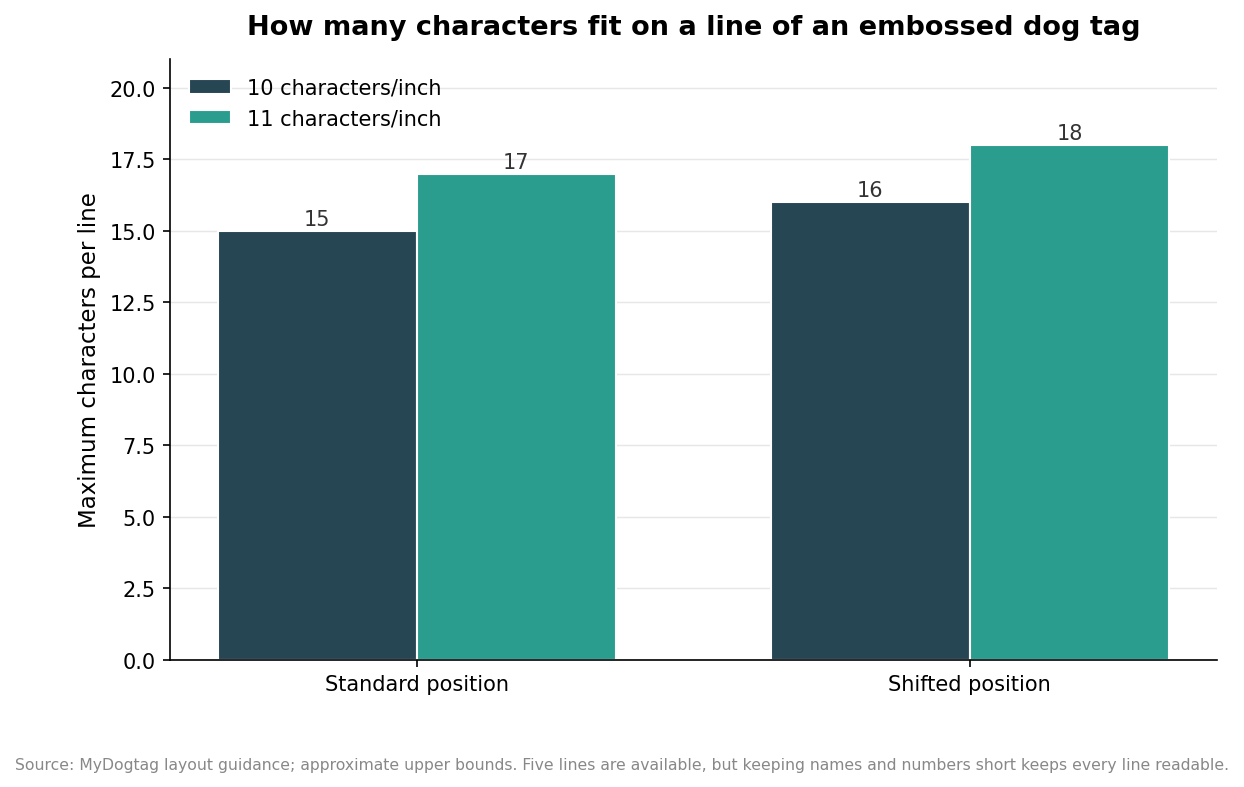
The practical lesson is to write short. A long surname combined with a long street name will not fit, and cramming a line to its limit hurts readability even when the characters technically fit. For a pet ID version of the format, the priority is a callable phone number rather than an address, and it is usually better to drop a line of text than to shrink and crowd all five.
Chains, silencers, and the notch
The set is more than the plate. A regulation configuration pairs a long beaded neck chain, commonly cited between 24 and 30 inches, with a short 4-inch chain that holds a second, identical tag. The two-tag system had a grim logistical purpose historically, but for custom work it simply means buyers often order in matched pairs. The chart below lays out the component dimensions of a standard set on one scale.
The rubber ring that fits around the tag’s edge is a silencer, and its job is exactly what the name says: it keeps two metal tags from clinking together, both to cut noise and to protect the lettering from wear. Custom orders use silencers as a color accent as often as for silence, since they come in many colors. As for the notch found on some older tags, the explanation most often given is that it helped align the blank in the embossing machine used at the time, not the widely repeated myth that it was wedged between a soldier’s teeth. Newer tags are usually notchless because the machines that required it were retired.
What custom versions copy and what they change
Most custom tags keep the silhouette, the stainless plate, the chain, and the five-line grid, because those are what make the object instantly readable as a dog tag. Where they diverge is the marking method and sometimes the metal. Beyond traditional embossing and debossing, custom shops frequently use laser engraving, which darkens the surface to form characters and allows lowercase, logos, and fine detail that a roller press cannot, though a laser mark sits on the surface rather than being formed into it. Rotary or diamond-drag engraving cuts a physical line into the metal for a durable, tactile result. Some novelty and promotional runs swap stainless for anodized aluminum to add color at lower weight, trading some of the lifetime durability that made stainless the standard. Each substitution is a reasonable choice as long as it is a conscious one: a colorful laser-marked aluminum tag is right for a giveaway, while an embossed stainless tag is right when the goal is a piece that reads as the real thing and lasts like it. Treat the numbers here as the published standard to design against, confirm exact dimensions and character limits with your maker, and the finished tag will honor the format it borrows from.