The material a dog tag is stamped from decides almost everything that matters afterward: whether the engraving is still readable in two years, whether the tag survives a dog that swims and digs, and how much a bulk order actually costs. Shape and color are easy to change later. The base metal is not. Getting that one choice right is most of the work of ordering a tag you will not have to replace.
Five materials cover the overwhelming majority of custom pet tags sold today: stainless steel, brass, anodized aluminum, plastic or silicone, and wood. They are not close substitutes. Each trades durability, weight, cost, and how cleanly it takes an engraving in a different direction, and the right pick depends far more on your dog’s size and habits than on the picture on the product page.
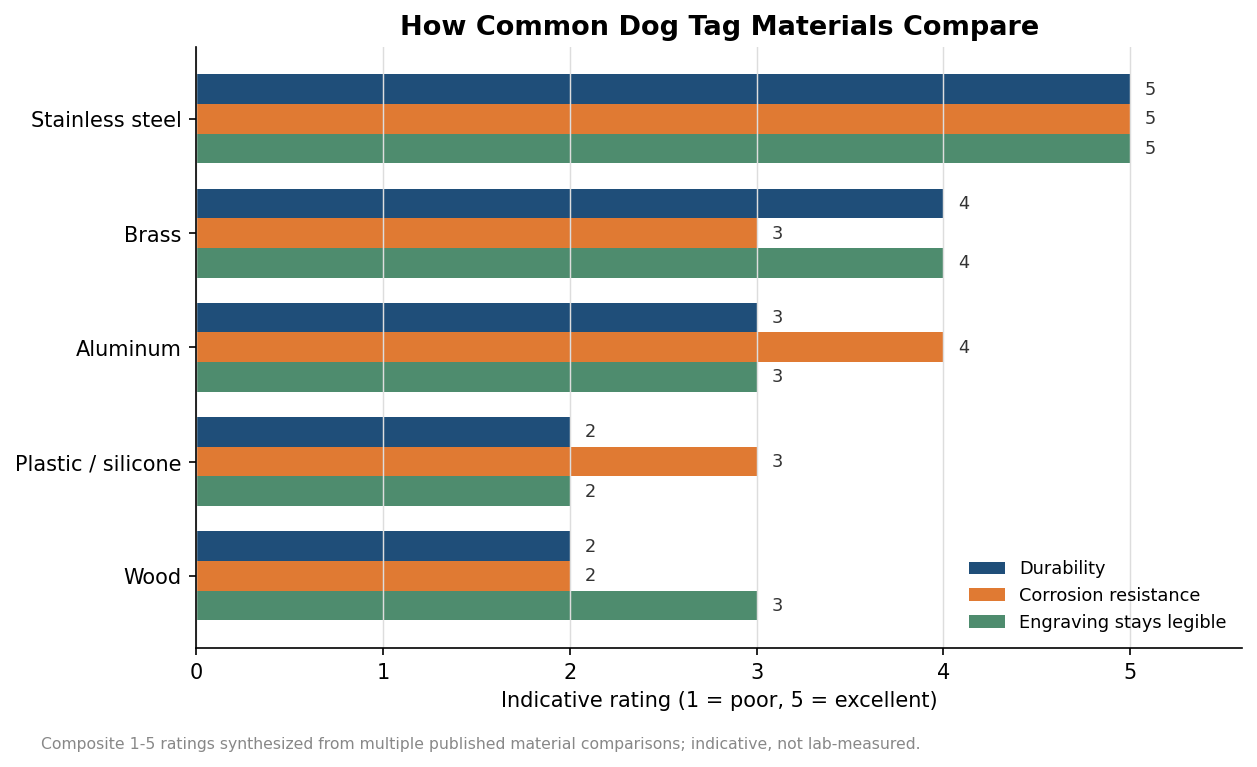
Why stainless steel is the default, and when it isn’t
Stainless steel earns its reputation. It resists rust and corrosion without any coating to wear through, it shrugs off rain, snow, and salt water, and a laser or deep-rotary engraving cut into it stays crisp for years rather than months. For a medium or large dog that spends real time outdoors, it is the safe default, and it is the reason nearly every military and working-dog tag is stainless. The one honest drawback is weight. A stainless tag has noticeable heft, which is fine on a 60-pound retriever and less pleasant on a four-pound puppy whose collar it outweighs.
That weight is the main reason the other metals still exist. Stainless is also harder to engrave than softer metals, so cheap machines sometimes produce a shallow mark on it that wears faster than the metal itself would suggest. If you order stainless, order it from a supplier that engraves deeply rather than lightly etching the surface.
Where aluminum, brass, and the soft options fit
Anodized aluminum is the lightweight specialist. It is rust-proof thanks to its natural oxide layer, it comes in a wide range of anodized colors, and it is usually the most affordable metal option, which makes it the sensible pick for a small dog or for a household ordering several tags at once. The compromises are real, though: aluminum is soft enough to bend and scratch with active use, the colored coating tends to flake after several months of hard wear, and a surface engraving on it can wear down faster than the same cut on steel. It is an excellent tag for a lapdog and a mediocre one for a dog that treats the yard like a job site.
Brass sits between the two. It engraves cleanly and crisply, it is corrosion-resistant, and many owners simply prefer the warm gold look. It is also the heaviest of the common metals and it oxidizes, developing a greenish patina that some people like as character and others have to polish off periodically. Brass is a style choice as much as a durability choice, and it is a good one as long as you know the patina is coming.
Plastic, silicone, and wood are best understood as purpose-built rather than budget versions of a metal tag. Silicone is genuinely useful for one reason: it is silent, so it does not jingle against a food bowl or wake a light-sleeping household, and it is a reasonable pick for indoor cats and quiet dogs. But printed information on plastic wears off relatively quickly, silicone grows brittle in sunlight, and wood swells, cracks, and rarely lasts more than a year outdoors. Treat these as comfort or temporary-ID choices, not as the tag you rely on for a dog that actually gets lost.
The engraving method matters as much as the metal
A durable metal with a poor engraving is a tag that goes blank. How the text is applied interacts with the material in ways that are easy to miss on a listing. Deep rotary or diamond-drag engraving physically cuts into the metal, so the letters survive even as the surface scuffs; this is what you want on stainless and brass. Laser engraving marks the surface and can look beautiful, but on softer or coated metals it is only as durable as the top layer it sits on. Embossing, the raised-and-recessed lettering used on classic military tags, is extremely durable because the shape of the letters is pressed through the metal, though it works best on thin stamped blanks. Printing, common on plastic and cheaper aluminum, is the least durable of all because nothing is actually cut or deformed.
The practical rule is simple: on a hard, corrosion-proof metal, insist on an engraving that removes or deforms material rather than one that merely colors the surface. A shallow laser mark on anodized aluminum can fade at roughly the same rate as the coating around it, which is why a tag can look worn out long before the metal has any reason to fail.
Matching the tag to the dog and the budget
Price tracks material fairly predictably, and knowing the drivers keeps you from overpaying or buying too little tag. Plastic and silicone tags sit at the low-cost end, anodized aluminum a step above, stainless steel in the broad middle, brass a little higher, and titanium at the top for owners who want maximum durability at minimum weight. Ordered in bulk, the cost per tag of every one of them comes down as the quantity grows, which is worth remembering if you are outfitting a kennel, a rescue, or a breeder’s litter rather than a single pet. For an exact figure on your quantity, request a free mockup and quote.
Put the pieces together and the decision resolves quickly. For most dogs that go outside, a deeply engraved stainless steel tag is the choice you will not regret; the extra weight is the price of a tag that stays readable for the life of the dog. For a small or toy breed, anodized aluminum buys most of the corrosion resistance at a fraction of the weight and cost, as long as you accept that the color coat is a wear item. Choose brass when you want the look and will maintain it, and reserve silicone for the specific problem of noise. Whatever the metal, the engraving method is not a detail to leave to chance: it is the difference between a tag that identifies your dog and a smooth blank disc that once did.