Category: Uncategorized

  • What to Put on a Dog’s ID Tag (and What to Leave Off)

    What to Put on a Dog’s ID Tag (and What to Leave Off)

    A custom dog tag has one job: get your dog home fast when someone finds him. That makes the engraving decision more consequential than it looks, because a tag is only as good as the information on it and how easily a stranger can read it in a parking lot. This is a practical walkthrough of what to put on a pet ID tag, what to leave off, and how to fit it all without shrinking the type into a blur.

    The one line that matters most

    A current phone number is the single most important thing on the tag, and if there is room, a second number for a partner, family member, or friend adds a crucial backup. Everything else is secondary to a stranger being able to reach you within a minute of finding your dog. Use a mobile number you actually carry, not a landline you rarely answer, because reunions happen fastest when the finder gets a live person rather than a voicemail. If you only have space for one thing, it is this.

    It helps to understand why the tag outranks the microchip for speed even though both matter. A chip is a backup that requires the dog to reach a shelter or vet with a working scanner and a correctly registered account. A tag works the instant a neighbor reads it. The two are complements, not substitutes, which the return-to-owner data makes plain.
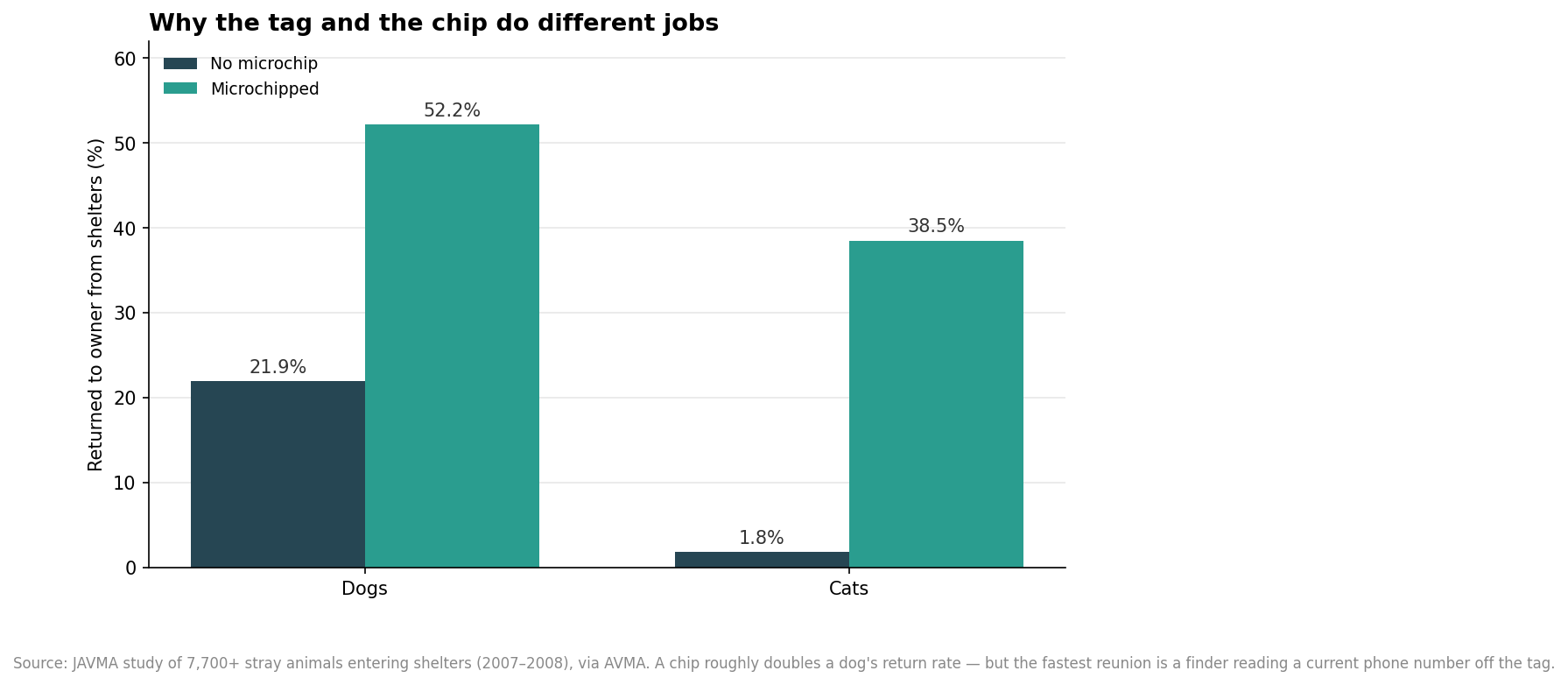
    Grouped bar chart of shelter return-to-owner rates: dogs 21.9% without a microchip versus 52.2% with, cats 1.8% versus 38.5%
    A microchip roughly doubles a dog’s shelter return rate, but a readable tag reunites the dog before it ever reaches a shelter.

    The takeaway from that data: a microchip roughly doubles a dog’s odds of getting home from a shelter, but the study’s authors found the usual reason chipped animals still weren’t reunited was incorrect or missing registration information. A tag with a phone number you can answer today short-circuits that whole failure mode. Wear the tag and keep the chip registration current; neither replaces the other.

    What else earns a spot

    After the phone number, a few additions pull their weight. Your city or general area helps a finder who has traveled, and it signals where to focus if the dog has roamed. A short “Microchipped” or “Scan me” note prompts a shelter or vet to check for a chip, closing the loop between your two layers of ID. If your dog has a medical condition, a clear “Needs meds,” “Diabetic,” or “Epileptic” line can be genuinely life-saving and tells a finder this is a dog to help quickly rather than hold onto. Finally, a brief reassurance like “I’m friendly” or a nudge like “Call my owner” costs little and can make a nervous finder more willing to approach and help.

    What to think twice about

    Two common inclusions deserve a deliberate decision rather than a default. The first is your full home address. Most guidance advises against engraving a complete street address, since the tag can end up in a stranger’s hands and a city or area gives a finder enough to work with. The second is your dog’s name, and here reasonable people disagree. Including it lets a finder speak to and calm an anxious dog, which can make the difference between catching him and watching him bolt. Omitting it is a security preference for owners worried that a stranger who can call the dog by name could more easily coax or claim him. There is no universally correct answer; decide based on your own risk tolerance, and know that the phone number, not the name, is what actually gets the dog home.

    Fitting it all without losing legibility

    Every extra line competes for space, and a tag crammed with tiny text fails at the exact moment it is needed. Prioritize ruthlessly: the phone number is non-negotiable, and each additional item has to earn its place against the cost of shrinking every character. Before you reduce the font, use the back of the tag, since a two-sided engraving roughly doubles your capacity while keeping the type large. Larger tags obviously hold more, but they are not always practical on a small dog, so the realistic move is to match the information to the tag size rather than force six lines onto a face built for three.
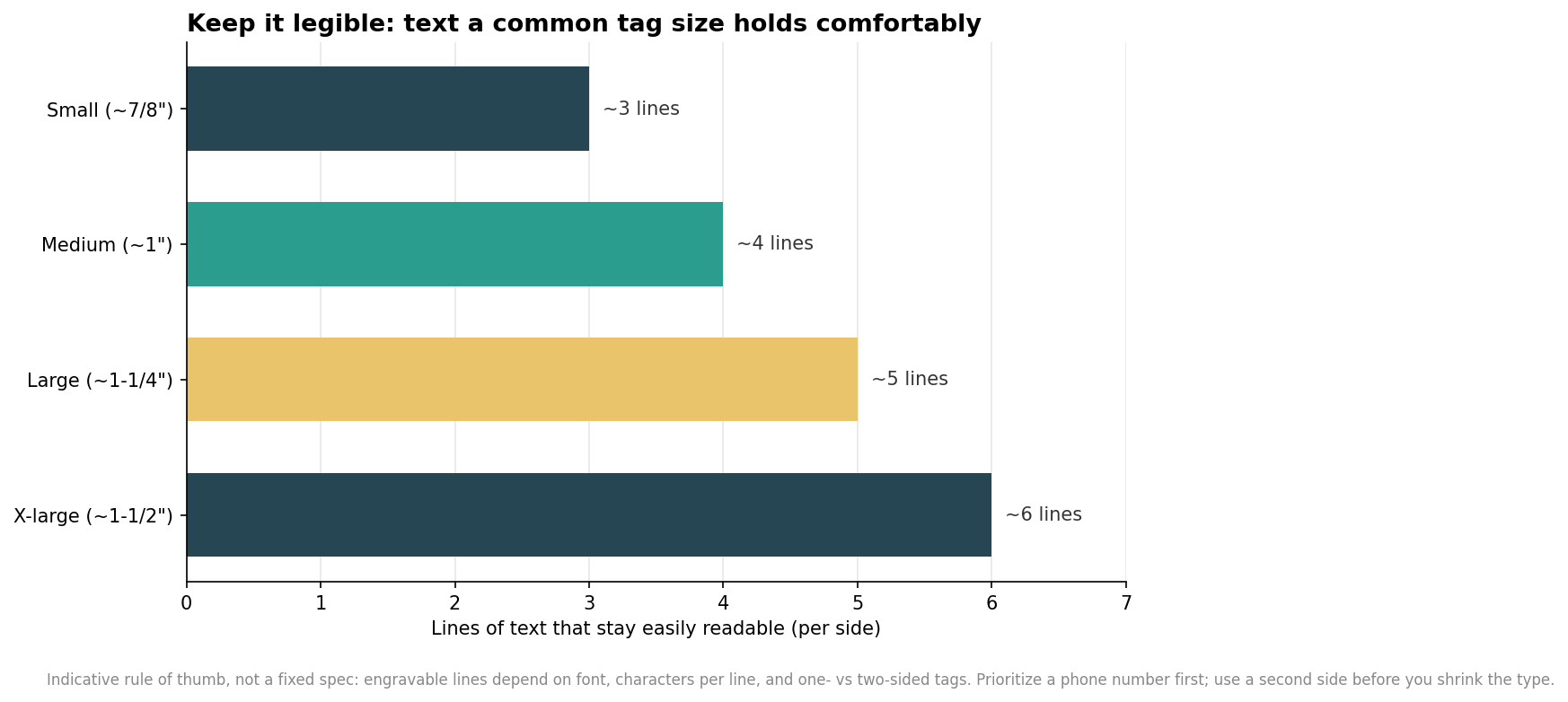
    Horizontal bar chart of indicative legible lines of text by tag size, from about 3 lines on a small tag to about 6 on an extra-large tag
    An indicative guide to how much text stays readable by tag size; use a second side before shrinking the type.

    Treat the figures above as a rule of thumb rather than a hard limit, because the true capacity depends on your font, how many characters sit on each line, and whether you engrave one side or two. A phone number with an area code is already a full line on a small tag, which is exactly why prioritizing matters.

    Ordering tags in volume

    The same rules scale up when the tags are for a rescue, shelter, breeder, veterinary clinic, or an adoption event rather than a single pet. In bulk, the smart move is to fix the layout and engraving depth once, decide as a policy what goes on every tag, and leave a variable field for the phone number and any per-animal detail. A rescue might standardize on its own contact number and a “Microchipped” line so every adopted dog leaves with working ID on day one, then hand the new owner instructions to add their own number. Locking the template keeps a large run consistent and readable instead of leaving legibility to chance tag by tag.

    A simple specification that works

    For most dogs, a durable tag engraved with two phone numbers, your city, and a short “Microchipped” note covers the essentials while staying easy to read, with medical information added when it applies and the dog’s name left to your judgment. Choose a tag size that holds that content at a comfortable type size instead of the smallest tag you can find, use both sides before you shrink the font, and pair the tag with a microchip whose registration you keep current. Do that, and the tag will do the one thing you bought it for: turn a lost dog back into a found one, quickly.
  • Stainless, Aluminum, or Brass: Choosing the Right Custom Dog Tag Material

    Stainless, Aluminum, or Brass: Choosing the Right Custom Dog Tag Material

    The material a dog tag is stamped from decides almost everything that matters afterward: whether the engraving is still readable in two years, whether the tag survives a dog that swims and digs, and how much a bulk order actually costs. Shape and color are easy to change later. The base metal is not. Getting that one choice right is most of the work of ordering a tag you will not have to replace.

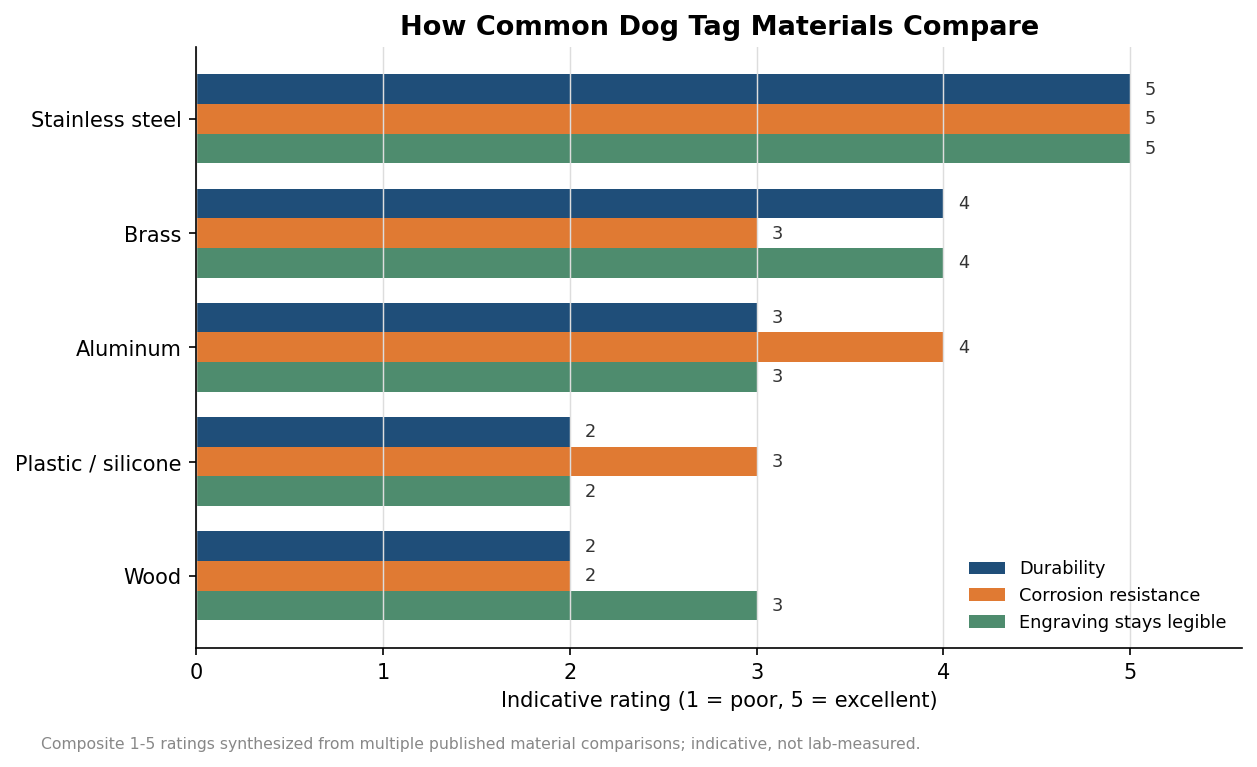
    Five materials cover the overwhelming majority of custom pet tags sold today: stainless steel, brass, anodized aluminum, plastic or silicone, and wood. They are not close substitutes. Each trades durability, weight, cost, and how cleanly it takes an engraving in a different direction, and the right pick depends far more on your dog’s size and habits than on the picture on the product page.

    Bar chart comparing durability, corrosion resistance and engraving legibility of stainless steel, brass, aluminum, plastic and wood dog tags
    Stainless steel leads on every axis; softer materials trade durability for weight or cost.

    Why stainless steel is the default, and when it isn’t

    Stainless steel earns its reputation. It resists rust and corrosion without any coating to wear through, it shrugs off rain, snow, and salt water, and a laser or deep-rotary engraving cut into it stays crisp for years rather than months. For a medium or large dog that spends real time outdoors, it is the safe default, and it is the reason nearly every military and working-dog tag is stainless. The one honest drawback is weight. A stainless tag has noticeable heft, which is fine on a 60-pound retriever and less pleasant on a four-pound puppy whose collar it outweighs.

    That weight is the main reason the other metals still exist. Stainless is also harder to engrave than softer metals, so cheap machines sometimes produce a shallow mark on it that wears faster than the metal itself would suggest. If you order stainless, order it from a supplier that engraves deeply rather than lightly etching the surface.

    Where aluminum, brass, and the soft options fit

    Anodized aluminum is the lightweight specialist. It is rust-proof thanks to its natural oxide layer, it comes in a wide range of anodized colors, and it is usually the most affordable metal option, which makes it the sensible pick for a small dog or for a household ordering several tags at once. The compromises are real, though: aluminum is soft enough to bend and scratch with active use, the colored coating tends to flake after several months of hard wear, and a surface engraving on it can wear down faster than the same cut on steel. It is an excellent tag for a lapdog and a mediocre one for a dog that treats the yard like a job site.

    Brass sits between the two. It engraves cleanly and crisply, it is corrosion-resistant, and many owners simply prefer the warm gold look. It is also the heaviest of the common metals and it oxidizes, developing a greenish patina that some people like as character and others have to polish off periodically. Brass is a style choice as much as a durability choice, and it is a good one as long as you know the patina is coming.

    Plastic, silicone, and wood are best understood as purpose-built rather than budget versions of a metal tag. Silicone is genuinely useful for one reason: it is silent, so it does not jingle against a food bowl or wake a light-sleeping household, and it is a reasonable pick for indoor cats and quiet dogs. But printed information on plastic wears off relatively quickly, silicone grows brittle in sunlight, and wood swells, cracks, and rarely lasts more than a year outdoors. Treat these as comfort or temporary-ID choices, not as the tag you rely on for a dog that actually gets lost.

    The engraving method matters as much as the metal

    A durable metal with a poor engraving is a tag that goes blank. How the text is applied interacts with the material in ways that are easy to miss on a listing. Deep rotary or diamond-drag engraving physically cuts into the metal, so the letters survive even as the surface scuffs; this is what you want on stainless and brass. Laser engraving marks the surface and can look beautiful, but on softer or coated metals it is only as durable as the top layer it sits on. Embossing, the raised-and-recessed lettering used on classic military tags, is extremely durable because the shape of the letters is pressed through the metal, though it works best on thin stamped blanks. Printing, common on plastic and cheaper aluminum, is the least durable of all because nothing is actually cut or deformed.

    The practical rule is simple: on a hard, corrosion-proof metal, insist on an engraving that removes or deforms material rather than one that merely colors the surface. A shallow laser mark on anodized aluminum can fade at roughly the same rate as the coating around it, which is why a tag can look worn out long before the metal has any reason to fail.

    Matching the tag to the dog and the budget

    Price tracks material fairly predictably, and knowing the drivers keeps you from overpaying or buying too little tag. Plastic and silicone tags sit at the low-cost end, anodized aluminum a step above, stainless steel in the broad middle, brass a little higher, and titanium at the top for owners who want maximum durability at minimum weight. Ordered in bulk, the cost per tag of every one of them comes down as the quantity grows, which is worth remembering if you are outfitting a kennel, a rescue, or a breeder’s litter rather than a single pet. For an exact figure on your quantity, request a free mockup and quote.

    Put the pieces together and the decision resolves quickly. For most dogs that go outside, a deeply engraved stainless steel tag is the choice you will not regret; the extra weight is the price of a tag that stays readable for the life of the dog. For a small or toy breed, anodized aluminum buys most of the corrosion resistance at a fraction of the weight and cost, as long as you accept that the color coat is a wear item. Choose brass when you want the look and will maintain it, and reserve silicone for the specific problem of noise. Whatever the metal, the engraving method is not a detail to leave to chance: it is the difference between a tag that identifies your dog and a smooth blank disc that once did.

  • The Military Dog Tag Standard: Size, Embossing, and What Custom Versions Copy

    The Military Dog Tag Standard: Size, Embossing, and What Custom Versions Copy

    The classic dog tag is one of the most copied objects in the personalization business. The oval stainless plate on a beaded chain that reads as unmistakably military shows up on custom orders for reunions, teams, memorials, promotional runs, and fashion, and almost all of them trace back to a single format the armed forces settled on decades ago. Understanding that original specification is useful whether you want a faithful reproduction or a custom tag that borrows the look while changing the details. This is a plain explainer of the standard and what versions built on it keep and drop.

    The tag itself: size, metal, and shape

    The standard tag is small, and its size is deliberate. A regulation-style dog tag measures roughly 2 inches long by 1.125 inches wide, cut from stainless steel with rounded corners and a thin profile on the order of a few hundredths of an inch. Stainless is the material of record because it resists corrosion and holds up for a lifetime of wear against skin and clothing, which is exactly why custom makers default to it as well. A single hole at one end takes the chain. That compact footprint is the constraint everything else works within: there is only so much room on a 2-inch plate, which is why the text rules that follow matter so much.

    Embossed now, debossed then

    The difference between raised and sunken lettering is the clearest marker of era on a dog tag. Modern military tags are embossed, meaning the letters stand raised above the surface, pressed up by a machine that pushes the metal outward. Raised characters are easier to read and to feel, and they hold contrast even as the surface wears. Tags from the World War II through Vietnam periods were typically debossed, with letters stamped down below the surface, which reads less cleanly and can fill with grime over time. When a custom order specifies an authentic period look, this is the detail that sells it; when it specifies readability, embossing is the better choice. The distinction also affects tooling, because raised and sunken lettering are produced on different machines.

    How much text actually fits

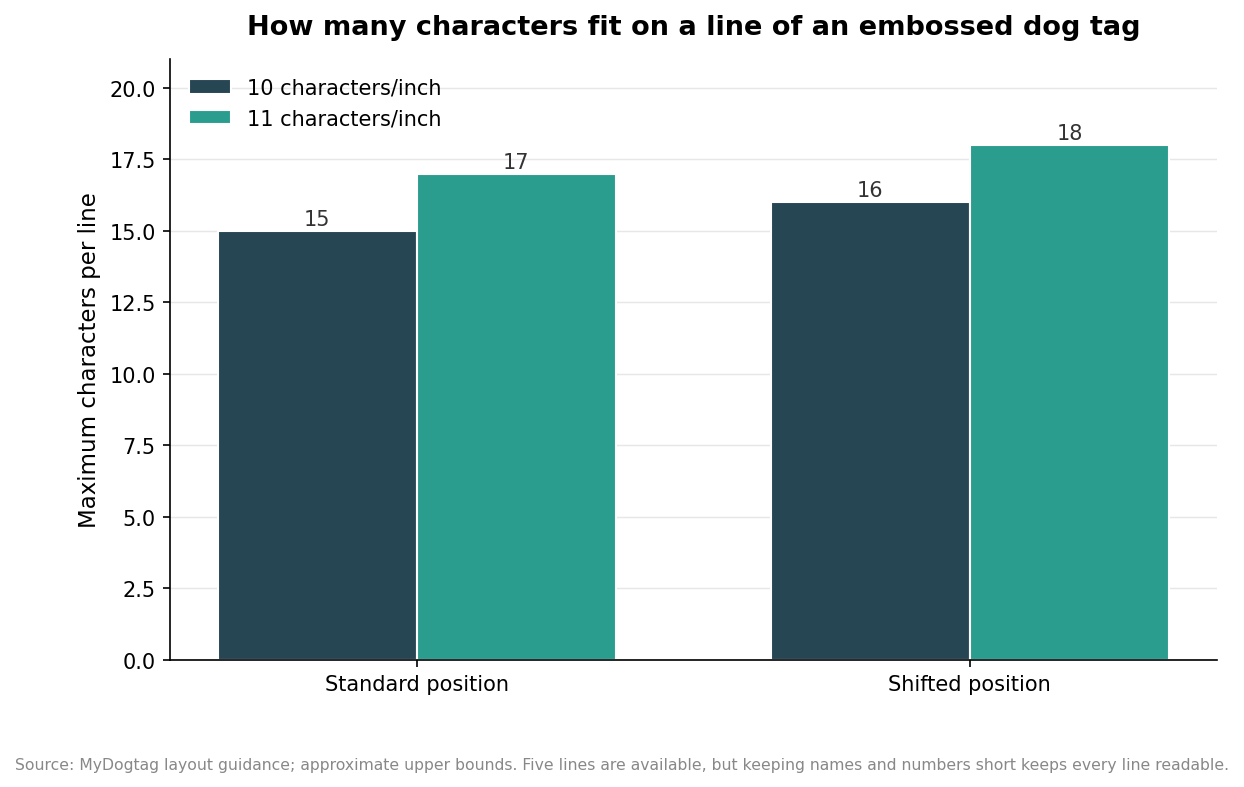
    The regulation layout is five lines, and the historical convention filled them with a service member’s name, identification number, blood type, and religious preference. What custom buyers most often underestimate is how tight those lines are. On a 2-inch tag, an embossing machine fits somewhere in the range of 15 to 18 characters per line depending on the pitch, which is characters per inch, and whether the text sits in the standard or a shifted position. The chart below shows those approximate upper bounds. Only capital letters, digits, and a few punctuation marks such as the dash, period, and comma are available, so lowercase and symbols are out.

    Grouped bar chart of maximum characters per line on an embossed dog tag by pitch and text position
    Approximate character limits per line on a 2-inch embossed tag, by pitch and text position.

    The practical lesson is to write short. A long surname combined with a long street name will not fit, and cramming a line to its limit hurts readability even when the characters technically fit. For a pet ID version of the format, the priority is a callable phone number rather than an address, and it is usually better to drop a line of text than to shrink and crowd all five.

    Chains, silencers, and the notch

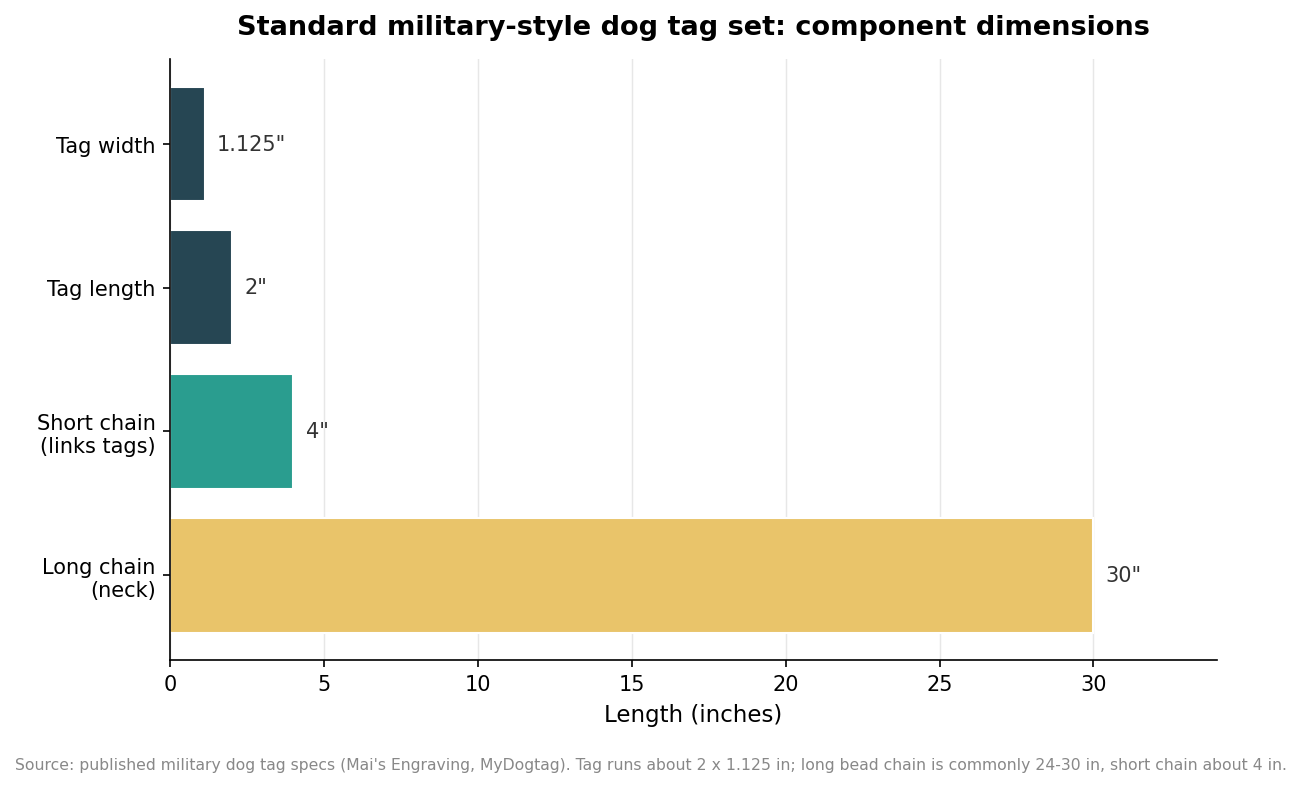
    The set is more than the plate. A regulation configuration pairs a long beaded neck chain, commonly cited between 24 and 30 inches, with a short 4-inch chain that holds a second, identical tag. The two-tag system had a grim logistical purpose historically, but for custom work it simply means buyers often order in matched pairs. The chart below lays out the component dimensions of a standard set on one scale.

    Horizontal bar chart of standard military dog tag set component dimensions in inches: tag, short chain, and long chain
    Component dimensions of a standard dog tag set, from the 2-inch tag to the long neck chain.

    The rubber ring that fits around the tag’s edge is a silencer, and its job is exactly what the name says: it keeps two metal tags from clinking together, both to cut noise and to protect the lettering from wear. Custom orders use silencers as a color accent as often as for silence, since they come in many colors. As for the notch found on some older tags, the explanation most often given is that it helped align the blank in the embossing machine used at the time, not the widely repeated myth that it was wedged between a soldier’s teeth. Newer tags are usually notchless because the machines that required it were retired.

    What custom versions copy and what they change

    Most custom tags keep the silhouette, the stainless plate, the chain, and the five-line grid, because those are what make the object instantly readable as a dog tag. Where they diverge is the marking method and sometimes the metal. Beyond traditional embossing and debossing, custom shops frequently use laser engraving, which darkens the surface to form characters and allows lowercase, logos, and fine detail that a roller press cannot, though a laser mark sits on the surface rather than being formed into it. Rotary or diamond-drag engraving cuts a physical line into the metal for a durable, tactile result. Some novelty and promotional runs swap stainless for anodized aluminum to add color at lower weight, trading some of the lifetime durability that made stainless the standard. Each substitution is a reasonable choice as long as it is a conscious one: a colorful laser-marked aluminum tag is right for a giveaway, while an embossed stainless tag is right when the goal is a piece that reads as the real thing and lasts like it. Treat the numbers here as the published standard to design against, confirm exact dimensions and character limits with your maker, and the finished tag will honor the format it borrows from.

  • Why Most Pet ID Tags Stop Being Readable

    Ask any shelter what fraction of stray dogs arrive wearing a tag nobody can read, and the number is depressing. The tag is there. The engraving is not. Something between the counter and the roadside polished it away.

    The three things that kill a pet tag

    Abrasion is first: a tag swinging against a collar buckle and a metal bowl thousands of times a week is being lapped, slowly and constantly. Second is depth — shallow rotary engraving on soft aluminum has perhaps a tenth of a millimetre to give before it is gone. Third is contrast: even a legible cut is unreadable at arm’s length if there is nothing dark sitting in it.

    Depth and hardness beat everything else

    A deep laser cut into stainless steel starts with far more material to lose and loses it far more slowly. That combination — depth plus a hard substrate — is the whole difference between a tag that lasts a season and one that lasts the dog’s life.

    Brass sits in between: softer than stainless, but heavy and easy to cut deep, and it darkens in the recesses as it ages, which quietly improves contrast over time.

    Use both faces, and put the number first

    The most common layout mistake is crowding a name, two numbers and an address onto one side in type too small to read without glasses. Both faces engrave at no extra cost. Put the pet name and one phone number on the face, everything else on the reverse.

    If you only have room for one thing, make it a phone number. A stranger who can call you does not need to know the dog’s name.

    Shape matters more than it looks like it should

    Bone and heart shapes lose usable engraving area to their outline, which pushes type smaller. Round and shield shapes carry more characters at a readable size. If the details are long, the shape is the first thing to reconsider.

    Ordering for a shelter or a practice

    Set the template once — your mark on the reverse, the owner’s details on the front — and every reorder afterwards is a spreadsheet. Variable data carries no setup charge here, so a batch of two hundred individually engraved tags is one order, not two hundred.

    Start with twelve. Hold them, hand a few out, then scale up on the same file.

    What we would order

    For a working dog: deep-engraved stainless, round or shield, both faces, split ring. For a shop counter: mixed shapes and materials so customers can choose. For an adoption program: stainless, templated, batch-engraved from a spreadsheet.

  • How to Lay Out a Medical Alert Tag

    A medical alert tag is not jewellery and it is not a medical record. It is a two-second message to a stranger who is busy. Almost every mistake we see comes from forgetting one of those three words.

    The emblem does the first second of work

    A recessed, red-filled medical emblem is recognised before any text is read. That is why it is on the face and why the fill has to sit down in a recess rather than on the surface — surface color wears off and takes the recognition with it.

    Condition first, always

    The single most important line is what is wrong, not who you are. Diabetes. Epilepsy. Anticoagulated. Severe nut allergy. Put it on line one, in the largest type the tag allows.

    Names belong further down. A responder treats a condition; they do not need to know a name to start.

    Then medications, then one number

    Line two and three carry critical medications or allergies — the things that change what a responder can safely give. Line four carries one emergency contact number.

    One number, not three. A list of numbers is a list of people to try, and nobody is trying three numbers at a kerbside.

    What to leave off

    Full addresses, insurance numbers, dates of birth and long medication histories. None of them change what happens in the first two minutes, and every one of them pushes the type smaller and the important lines further down.

    If there is genuinely more to say than six lines, the answer is a second tag or a wallet card — not smaller text.

    Material and wear

    304 stainless steel, because it is worn every day for years against skin and does not react or discolour. Beaded chain as standard; silicone-sleeved chains and wrist versions for people who cannot wear beaded metal, and a short chain so the tag can move to a school bag or a kit.

    Ordering in batches

    Clinics, schools and sports programs usually order these as a batch with different text on every tag. Send a spreadsheet, one row per person, and every tag comes back individually engraved with no per-piece setup. We will send a layout proof of the first few before the run.

  • The Complete Buyer’s Guide to Custom Dog Tags

    Every question people ask about ordering dog tags reduces to two: how the marking is made, and what it is made in. Get those right and the rest is layout.

    This guide covers both, plus the details — line lengths, fittings, variable data — that decide whether a batch arrives usable or merely correct.

    Embossed versus engraved

    Embossing presses raised characters into steel under pressure. It is the original military method and it cannot wear off, because the metal itself has been deformed. What it cannot do is fine detail: no logos, no small artwork, no curves tighter than the character set.

    Laser engraving cuts into the surface instead. It holds logos, crests, line art and QR codes at sizes stamping cannot approach, and on hard materials it stays legible for years. On soft plated stock it does not, which is where cheap engraved tags get their reputation.

    Choosing the material

    Stainless steel for anything worn daily against skin. It does not react, does not discolor, and takes both embossing and deep engraving.

    Anodized aluminum when color and weight matter — roughly a third the mass, nine shades, and the laser cuts through to bright metal for high contrast. Brass and copper for keepsakes that should darken with handling. Coated aluminum when the tag must carry a photograph, which no engraving process can do.

    Layout: five lines, fifteen characters

    The military layout is five lines of fifteen characters, and it is a good default even for civilian jobs because it is what the format was designed around. Longer names break across lines in ways that look wrong, so we show the exact break on the mockup before stamping.

    For medical alert tags the rule is different: condition first, then critical medications or allergies, then one contact number. A responder scans for the emblem and the top line, not a paragraph.

    Fittings are not an afterthought

    A tag with no chain is half an order. Beaded neck chains and short chains come as standard on military sets; pet tags need a split ring or an S-hook; medical tags sometimes need a silicone-sleeved chain for someone who cannot wear beaded metal.

    Tell us how the tag will be worn and the fittings come in the same box, rather than in a second order two weeks later.

    Variable data changes what is possible

    Individually marking every tag in a run used to carry a setup charge per piece, which meant batches got ordered blank and hand-written later. It does not here: send a spreadsheet with one row per tag and every piece comes back marked.

    That is what makes shelter adoption tags, athlete roster tags and school allergy tags practical to order in one go rather than in dribs.

    What to send us

    The material you are leaning toward, roughly how many, and either your text or a spreadsheet of it. If a logo is involved, send whatever file you have — a photo of a patch is enough — and we will redraw it as vector art free and show it on the tag at actual size.